



 Newsletter
 Online Store
 Login
Login


RACE INFO

RACE INFO
Namib Race Blogs 2026
8
PostsNamib Race (2026) blog posts from Tessa Djarv
27 August 2026 09:09 pm (GMT) Greenwich Mean Time: Dublin, Edinburgh, Lisbon, London
Some few words to end with,
Firstly, I DID IT! A challenge beyond what I would believe me to be capable to do. I did it, I did not get injured and had so much fun, I met so many warm persons along the way and the whole RTP team was so professional with focus on important stuff.
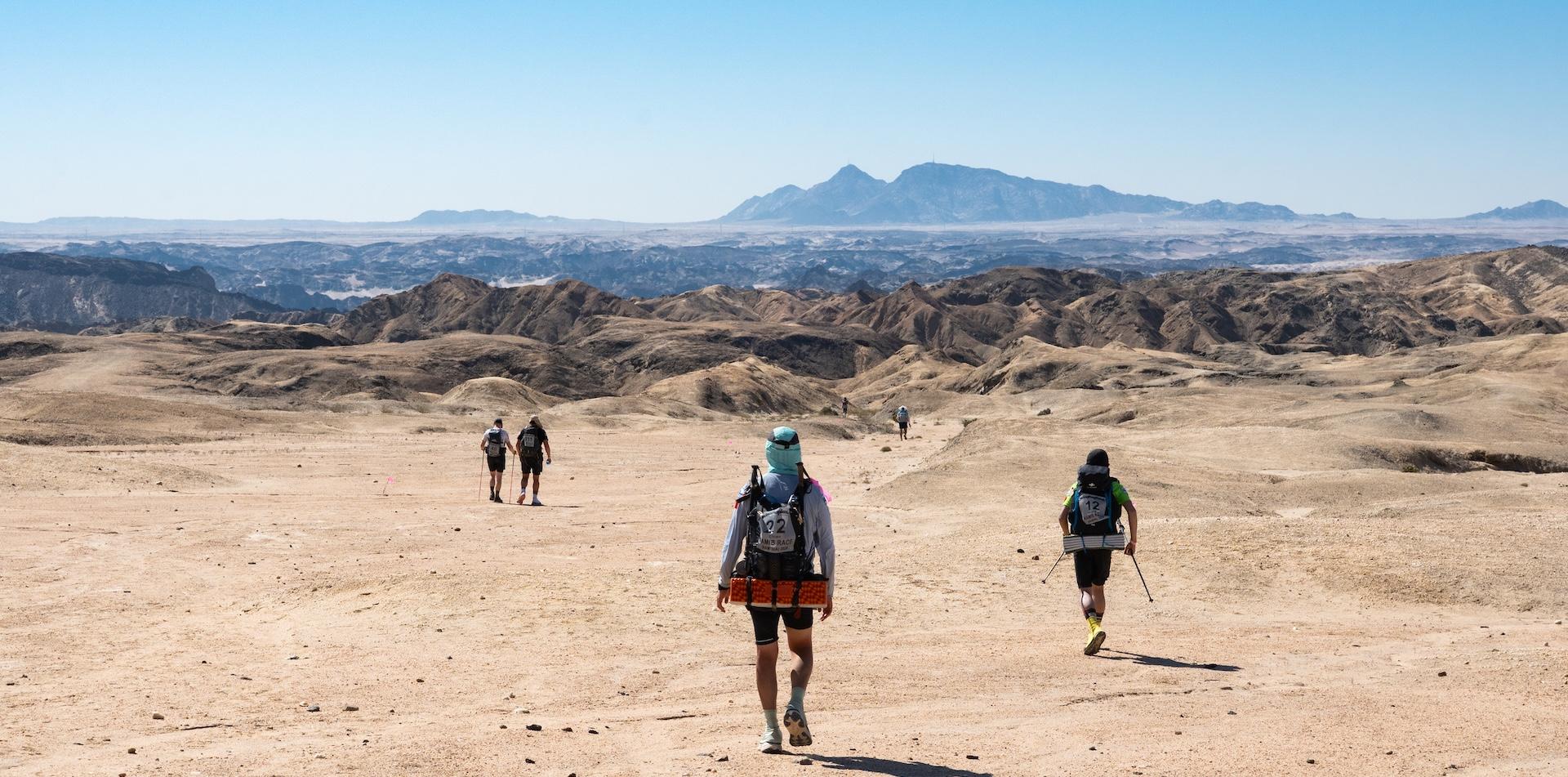
It is not possible to summarize it all, but it was brutal and awesome. The desert was as hot as 45C, the sand was as loose as can be, uphills as boring and neverending as could be. The desert is brutal, each and every mental and physical flaw will be obvious to you. But also the moments when everything was just about me running in the desert with only a feeling of pure joy within me felt like a re-start of the brain.
What would I do differently?
Well, eating is not fun and I was rarely hungry, I preferred to eat someting with spices or just sweets. Bars tend to just grow in the mouth. So daytime energy would be better from sweets, energy cubs/gums and a some chili would do so much for the dinner.
Fluid and salt- I think I needed more salt than I planned, I did not ran out of it, but I really got a taste for salt. I would add salt tablets.
Equipment- fine, no changes.
Pre-training... difficult... I did it, I finished without injuries...but maybe do more back-to-back long distances with heavier backback over daily 60min runs some weeks in the later third of the training programme?
Also... blend more with locals... I got my hair braided by one of the locals, felt like the best hair salon I been to :)
I would highly recommend you to do it!
03 August 2026 09:36 pm (GMT) Greenwich Mean Time: Dublin, Edinburgh, Lisbon, London
YAY!
14 days to adjust, think, check and re-check.
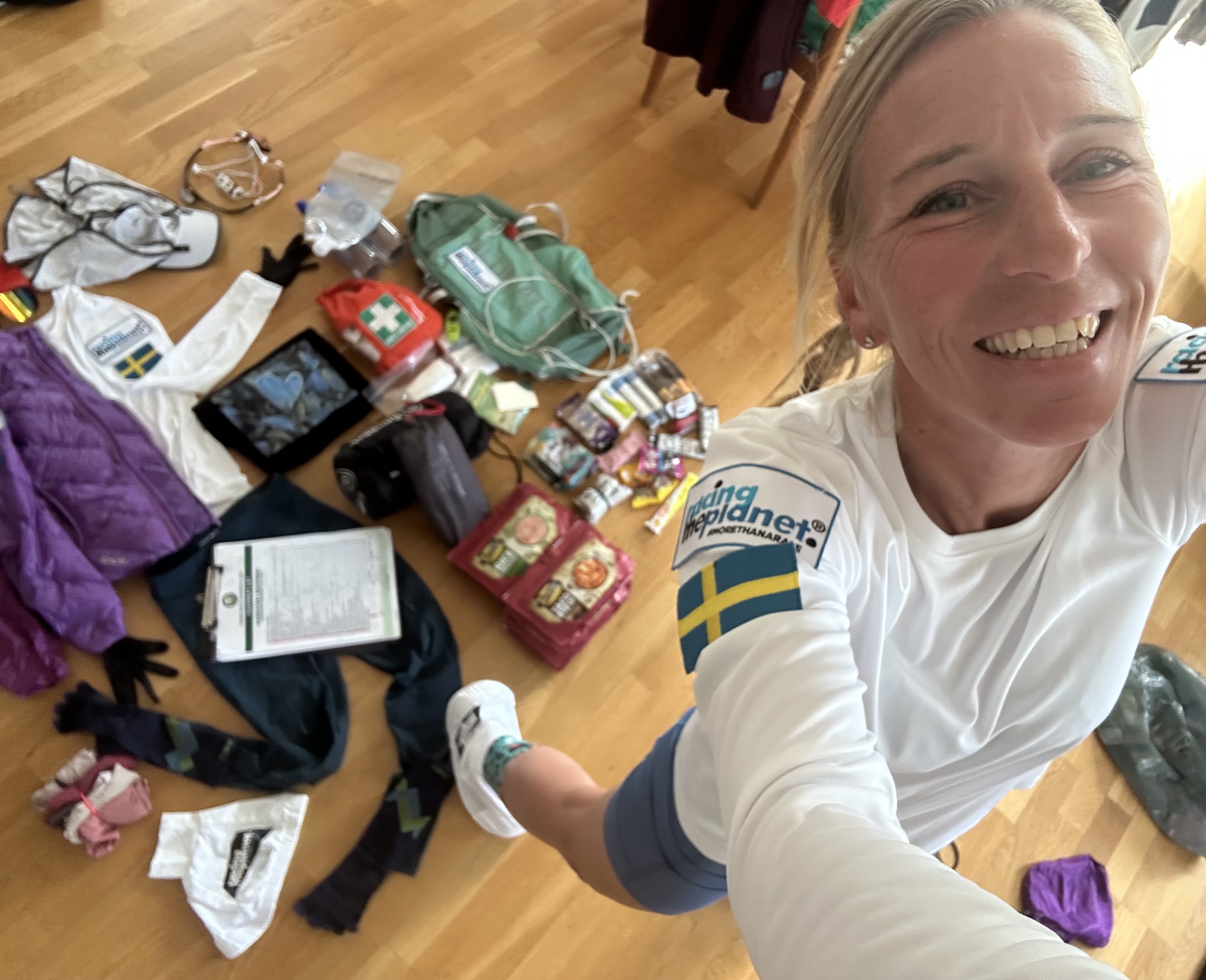
How many times do I really need to check and re-check all equipment? And make sure that everythings fits into the backpack, I already know it will be tight, but somehow I do not trust my last experience that all went in the bag in the end... Also, I really need to keep the weight down, it will anyhow be about 8-9kg incl water which is +15% of my body weight. So I weighted every single item, see below.
I have been out sailing for the last 4 weeks, wonderful but not so easy to combine with running. But I tried to stretch the legs at elast some kilometers on every single island we anchored at. In the backward mirror it felt like I did no running but it sort of summed up to about 35-40km weekly, so not the worst... On the first day on land again I had to test myself, loaded my backpack with 7.8kg and set out a 32km trail, went well even if the pace was slow. My body did not scream more than usual but mentally it felt so important! Now I will just do short fun-runs until the race day.
How many kilometers are in my legs from signing up in March? Just summarized it to 1211km, i.e. weekly average of 55km (range 25-100km). 540km (45% with a my backpack, from 3-10kg, most often around 6kg) Is it enough? I would not know, in a dream world it would have been more, but it is what it is. My pace varies a lot, mostly due to the surface. I have no expectations at all regarding time, I only aim to make it to the finish line with a smile!
Will soon travel to Namibia, look so much forward to it!
Summary of all equipment:
Backpack Ultimate Direction Herfastpack 20 (560g)
Waterproof bag Ospray 35l (83g)
Hydration system: 3 bottles a 650ml+ 1l flatbottle (platypus) (25g empty :)
Sleeping bag- not sure yet... Checking for a lighter option... Will add liner as well.
Running shoes Ascice trebuco (566g)
Socks- 3 pairs of injiinji toesocks (144g) ´+ extra pair of regular running socks?
Tights- short patagonia (100g) + long sweaty betty (180g), both with dual leg pockets (very difficult to find!!)
Running shirts-long sleeve (135g incl 16g of patches per shirt)
Warm jacket- haglöfs lim series (145g incl 16g of patches)
Waterproof jacket- Outdoor research (170g incl 16g of patches)
Rain poncho (54g)
Cap with neck cover- outdoor research (84g)
Warm hat- haglöfs beanie (19g)
Gloves- hestra liners (23g)
Sunglasses- unknown brand (36g)
2 headlamps- Petzl IKO core + 4*3Li batteries and Petxl bindi as backup (120g+ batteries)
Red flashing light- unknown dog brand (24g)
Multi-tool- swiss army knife with scissor
Whistle+ compass (26g)
Mirror + survival bivvy bag from RTP (122g)
Sunscreen 50 40+40ml (122g)- might add more?
Lip sunscreen Hawaiian tropic 50 (9g)
Medications- paracetamol + others
Blister kit (134g)- might add more tejp
Compression bandage (23g)
Safery pins 10pcs (4g)
Alco gel 60ml (86g)
Toilet tissue + wet wipes + body wipes (100g)
Eating utensil- TWO- if I drop one! Sporks (18g)
Optional equipment
Sleeping pad- RAB (354g)- worth sleeping well ...
Gaiters RTP (76g)
Foldable coffee cup (25g)
Underwear 180g
Toothbrush + paste (25g)
Iphone (206g)- for photos only
Small watch
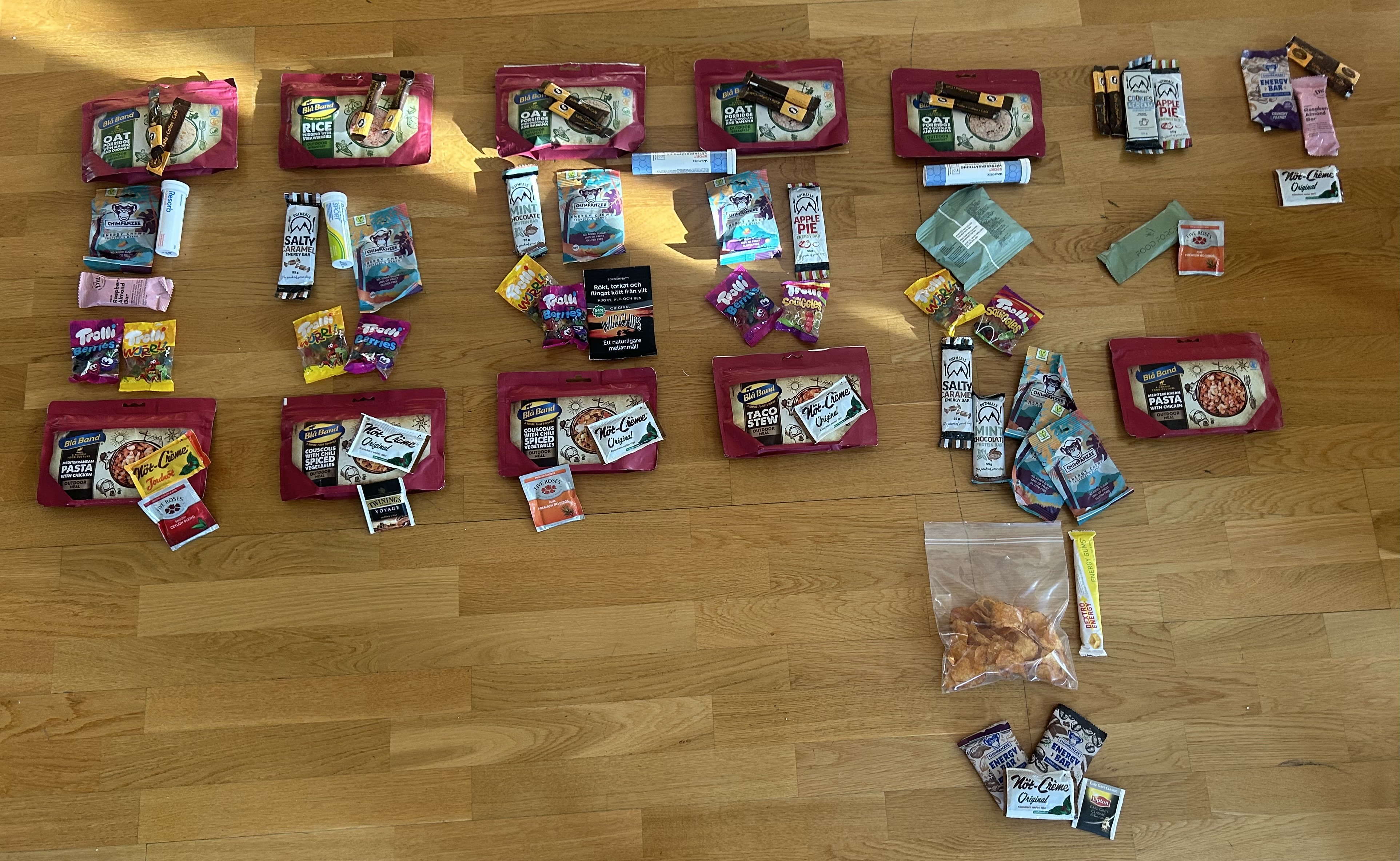
Food.. see picture below... about 3500g for 13000calories... will add some more snacks.
Comments: Total (1) comments
Elke Slinger
Posted On: 05 Aug 2026 10:00 am
27 June 2026 02:02 am (GMT) Greenwich Mean Time: Dublin, Edinburgh, Lisbon, London
I got inspired to do a mini training camp as planned by the other participant Karen – the self-proclaimed "Queen of Procrastination" (see her Namib Race 2026 blog).
This week I escaped to my summer house with Dusty (my trusty green backpack) and my laptop for what I hoped would be the perfect work-life balance week. 😊
Mission accomplished! My goal was to run four consecutive days with Dusty on my back, covering a total of 100 km. I packed her with 6.5 kg—still a bit lighter than my race load, but heavy enough to make the training worthwhile.
Day 1 – 30 km
A sunny day and warm-as- it-gets-in-Sweden-day, perfect running conditions! Mostly trails and gravel roads. I wore my race shoes, although I'm trying not to overuse them before Namibia, so they'll mostly be reserved for my longest training runs. Almost feels like a small treat to wear them.
Day 2 – 25 km
Another warm day, though with a few clouds. About one third was on sandy beaches, tried to avoid the easiest part most close to the sea, but how difficult that was… My body and mind unconsciously seems to seek the easiest track. Towards the end of the run I started feeling hot spots on my lower back. Perfect! I know I'll get some chafing from the backpack during the race, but until now Dusty has been surprisingly kind. Finally, she decided to fight back.
Day 3 – 26 km
Cloudy but comfortable weather. I taped the sore spots on my back before heading out, and it worked perfectly. However, another part of my back started complaining—higher up this time. I couldn't see or feel anything obvious on the outside of the backpack, but when I unpacked the backpack I discovered the culprit: my spoon. I had packed it with the convex side facing my back. One small adjustment, turning it the other way around, and the problem disappeared. Amazing how something as simple as the orientation of a spoon can make such a difference over 26km.
Day 4 – 20 km
A slightly slower day, but still well within my target pace. Tried out a new sunscreen, worked well without irritating eyes.
So... 100 km in four days carrying 6.5 kg. What did I learn?
This race really rewards attention to the smallest details. Things like which way your spoon faces inside the backpack can determine whether your back is happy or miserable after a long day. Provoking hot spots and blisters during training is actually a good thing—it gives me the chance to test taping strategies and learn how to prevent problems before race day.
Time is another lesson. I know I'll be slow, and I'm completely fine with that. Instead of focusing on pace per kilometre, I'll make daily time simulations with estimated checkpoint times. Pace varies enormously depending on the terrain, how often I stop to eat, and—perhaps most importantly—how social I'm feeling. I experimented with some (run)walk-and-talk sessions this week. They made the kilometres disappear but definitely didn't improve my speed! During the race, though, I'm really looking forward to chatting with fellow participants.
Perhaps the biggest takeaway is this: I can do it. Four consecutive days, 100 km, no injuries. That's a confidence boost. I'm actually starting to long for the start line.
Focus for the coming weeks
The priority now is simply to maintain my running. Rather than spreading my weekly mileage over many days, I think it will benefit both my body and my mind to combine it into fewer, longer runs. That also fits much better with the summer holiday plans.
Namibia suddenly feels a little closer, in the most positive way!
Comments: Total (2) comments
Michaela Punz-Raml
Posted On: 29 Jul 2026 06:25 pm
Sam Fanshawe
Posted On: 29 Jun 2026 06:29 am
09 June 2026 08:09 pm (GMT) Greenwich Mean Time: Dublin, Edinburgh, Lisbon, London
Over the past few weeks, I have received an incredible amount of love and support from so many people. Why?
I decided to share my adventure on LinkedIn (the link looks a little strange, but it works perfectly well): https://www.linkedin.com/posts/therese-djarv-413b63128_to-live-a-life-i-cannot-imagine-what-it-is-activity-7467842721291059200-fXBb?utm_medium=ios_app&rcm=ACoAAB9-wI8BB2hcKXxfzYo0IzRF89FNcqexWXs&utm_source=social_share_send&utm_campaign=share_via
I did not post it for myself, but because of the charitable aspect of this Namib challenge. I have chosen to raise funds for our cardiac arrest survivors. Perhaps they would like an in-person gathering next year? That is entirely for them to decide. If you would like to contribute, please do so here: Fundraiser by Emma Therese Djarv : Cardiac arrest survivors network
I have been — and, if I am honest, still am — nervous about the challenge that the Namibia Race presents. What if I tell everyone about it and then injure myself on day one? Not simply through bad luck, but because of poor preparation, inadequate blister prevention, or, even worse, because I underestimated my hydration or salt requirements.
Perhaps that would be embarrassing. But I think I have reached a point where the purpose of the fundraising has become more important than my fear of failure. What matters is being able to give something back to cardiac arrest survivors and their co-survivors. Over the years, I have met so many courageous survivors and co-survivors. They have generously shared their experiences, their struggles, and their fears. Their openness left me with little choice. What it is to fail a race compared with what they have faced? And who am I to pretend that success means getting everything right all the time?
Success is sharing joy, tears, and fears with others. By sharing my post, I have received an abundance of encouragement, insight, support, and kindness. Every message, every conversation, and every word of advice will carry me to the starting line — and, I hope, all the way to the finish line. Thanks people, you are awesome!
About 2 months to go! Plan for now:
1. Upcoming month: Stay at current weekly kilometer volume (app 70km/week) but spend more time with Dusty (the backpack!). I read some research done on the race, found this study: Effect of Sodium Supplements and Climate on Dysnatremia During Ultramarathon Running. Except for really raising awareness of the issue with salt balance, I noticed that the avarage weekly volume seems to be around 70km among participants but also that many had "greatest running distance" of 120km in at least one week... We will see if I get there in my preparations.
2.The following month. Well.. vaccation in Sweden means sailing.... and sailing and longdistance running is somewhat not compatible. But I reassure myself that this period will give my body time to heal micro injuries and get the longing to run back !
Don’t wish me luck. Luck is not what either I or the survivors need. What we need is structure, persistence, and thoughtful encouragement.
/Tessa
Comments: Total (1) comments
Samantha Fanshawe
Posted On: 10 Jun 2026 06:36 am
31 May 2026 06:08 pm (GMT) Greenwich Mean Time: Dublin, Edinburgh, Lisbon, London
Summer is coming to Sweden! Yay!
Except for everything wonderful with the Swedish summer it also comes with at least some higher temperatures, not close to Namib, but still some. Heat training is important but difficult in the northen hemisphere. I have seen some scenice on post-exercise sauna. And, the Swedish national fotball team just revealed that they will use sauna (15+15min) as a part of their heat -training before the world cup.
Training is according to plan, feels great! Did about 70-80km three weeks in a row now without injuries. My friend, the emerald green backback (ultimate direction filled with stuff -7.5kg) has joined me for about 20-38km/week, so I take it really slow. I have learned to not look at time/km at all, instead either total time or total lenght of the run.
Longruns. I prefer to "run" for 25min and then walk&drink for 5min. I have discovered that Im really slow on walking, but Im happy as long as total time is better than the time limit for the race. This weekend I managed to do 4hrs yesterday and 2hrs today with my friend (the backpack), btw I think it is time to name her since she needs to hang out even more with me from now on... how about Dusty?
Weekly volume. It is time consuming to do all of these runs and I cant really make up my mind regarding if it is better to do shorter (10km) daily or longer runs (15-20-25km) every other day. The shorter once are easy to fit in to job schedule. The longer are mentally rewarding. There is also a third option, in the RTP intermediate training plan it also seems important to do two runs per day 45+60min or something like that. The benefit of two runs/day is to get my legs used to re-start after a break. Maybe it is not worth getting to philosophic about this, just run?
Plan ahead:
1. Hills! I need to show Dusty hills, I live in a flat area, but there must be some smaller once at least. It will be a mental training, how many times can you run up&down a small hill?
2. Heat-training. Try to run when it is the hottest and most sunny time of the day, and not seek the shade (from a tree, house etc) when possible. I also post-exercise sauna :)
3. Food plan refinement. Discovered that I do not like to eat nuts while running, but crushed crips are fine. And mango :)
4. Keep running weekly km-volume, around 80km?
To sort out upcoming month:
1. Multitool- oh, what a variety there is. What tools will I need? Any advice from anyone?
Still 77days to nervous, consistent and thrilled!
/Tessa
16 May 2026 06:30 pm (GMT) Greenwich Mean Time: Dublin, Edinburgh, Lisbon, London
Yay, 92 days to go!
Last month went fast, I managed to stay uninjured (in the northen part of sweden where I was born, we just add the swedish "un" to any word, not sure how it works in english or even in the other parts of sweden :)! For example, you can be un-eaten, un-tired and even un-runned for the day meaning you have not done your planned running yet :). Or just un-injured!
Anyhow,I have managed to:
1. Gradually increase the volumes of weekly km, this week it sums up to 70. I think I will stay here for 2weeks, back down to 50km and then up again? We will see. I try to adhere to the training plan by RTP: Training Plans - Features | Namib Race 2026. But sometimes I just do what I feel for, again any km is better than none.
2. Run with what I guess (hope!) is near my backpack weight (without water) 7kg for 2,5hrs. Decided to run 25min in a slow pace and then walk 5min and so on.
3.Understand that not only weight but also the shape of the backpack affect where hot spots might show up.
4. Attach velcro to my shoes, the nicest shoemaker ever in the local mall did it for me. Will try it out on next weeks long-run. I bought the gaiters from RTP: Race Equipment - Gaiters – RacingThePlanet Limited
5. Make a food plan. Currenly +15 000cals on 3.700g. Will add some more sweets/crisps in the end. Great template at the RTP webpage: racingtheplanet-food-plan-template-excel.xlsx
6. Get hold of most mandatory equipment, just 1-2 things left, such as which multitool to add.
7. Run with tejp on my heels, worked ok. Tried toe socks by Injinji, wonderful! No blisters at all on runs lasting 2-3 hrs.
8. Upload all mandatory documents, signed up for this insuranse: ITRA Insurance About
To do upcoming weeks:
1. Stitch RTP + SWE flags to all tops
2. Try to run 2,5hrs with full backpack two days in a row
3. Keep reading up on things. I have discovered that I need to read a lot about the race, it makes me stay motivated and curious but also helps prepare the mental part of the race. Beeing a researcher, I found very interesting and amazing studies about RTP: RacingThePlanet - Medical Research
Soon 91 days to go, longing for the sand!
/Tessa
Comments: Total (1) comments
Sam Fanshawe
Posted On: 17 May 2026 08:28 am
15 April 2026 08:10 am (GMT) Greenwich Mean Time: Dublin, Edinburgh, Lisbon, London
At times, life simply doesn’t allow me to follow a training plan. So what do I do then?
I focus on the long run—literally and figuratively—and remind myself that a kilometre done is better than none. Keeping my running shoes packed creates opportunities: a quick 20-minute run before breakfast, or a short session before dinner at a conference.
Perhaps these unplanned breaks even help heal micro-injuries. At the very least, they clear my mind, sharpen my appetite before breakfast, and make me feel ready for whatever the day brings.
Increasing My Chances of Finishing the Namib Run
Despite less-than-perfect adherence to training, here’s my plan:
- At least one week with a 3-hour run on two consecutive days
- Reach at least 50 km in a single long run
- Bring my backpack regularly
- Gradually increase weekly volume (currently 35–50 km—every kilometre counts :)
And Then There Are the “Ghosts”
1. Blisters—my biggest brain ghost
I’ve been to Namibia many times. You have to be sandlover -it’s everywhere, and it’s magical. I love running downhill on the dunes. Walking up them, in 30-degree heat, is another story entirely. But the sand… it gets everywhere. Lubricants? I’m sceptical in sandy conditions. Gaiters—definitely. Tape—probably early on, and perhaps in unexpected places. A small brush to clear sand from between the toes?Advice from previous finishers would be gold here!
2. Dehydration and electrolytes
On runs shorter than 2–2.5 hours, I usually don’t eat or drink. The Namib will not allow that approach.
Training plan at home:
On runs longer than 2 hours, alternate 25 minutes of running with 5 minutes of walking and drinking.
Race strategy:
- 2 Resorb tablets before the start
- 1 tablet per hour during the race
- 2 tablets at camp
Fluids:
Around 5 dl per hour as a baseline—likely more in the heat, especially in dunes and on climbs. Roughly 3–4 dl at each checkpoint, depending on what’s allowed. And if possible, pouring some water over my head or cap to manage the heat.
Ghosts I’m Less Worried About
- Hunger: I can handle it—it fades. I’m good if I get sweets (salt licorice!) and morning-coffee is non-negotiable.
- Runner’s stomach: Expected. Deal with it and move on.
- Freezing nights – no, I’m a warm person. I will have a sleeping bag and liner + add non-mandatory sleeping pad that I have used in freezing conditions in the Namib Desert before. Will change into dry, loose clothes closest to the body.
- Injuries: Old ones may resurface. I’ll listen to my body, adjust when needed, but won’t overreact unless pain escalates.
- Being the slowest: Someone has to be—and that’s perfectly fine.
Things to Figure Out
- Will flip-flops feel like a foot spa at camp—or just add unnecessary weight?
- Sunglasses: I’ve never run with them. How do you even choose the right pair in an overwhelming market?
Piece of ”Evidence-Based running”
Running shoes: in summary—pick the ones you like.
https://www.cochranelibrary.com/cdsr/doi/10.1002/14651858.CD013368.pub2/information#CD013368-cr-0004
I will use ASICS Trabuco terra 3 without goretex
07 April 2026 08:21 pm (GMT) Greenwich Mean Time: Dublin, Edinburgh, Lisbon, London
Dear all,
What on earth have I signed up for? And why?
The latter part seems to be important for finishers, at least if you read previous blogs and reports. When times get tough, not if.. only when.. past participants says that only your inner motivation will guide you. I know my reasons but will they be sufficient?
I know others have done a much harder thing than I will do. My passion in life is to do whatever I can to support survivorship after cardiac arrest. Those few who survive globally have all done something much harder than a volontary race and one of the things I will do is try to gather funding for a physical meeting for survivors in Sweden. Every step towards the finish line counts https://gofund.me/27c5168c9
While the days run by, I will keep running according to the training plan provided by racingtheplanet, works well so far- but is it enough? I have repacked my backpack several times, with half of the mandatory stuff it is quite full and feels heavier than the kilos... where will my blisters appear?
Many questions... if you read this, add your best advice :)
Comments: Total (1) comments
Angela Alchin
Posted On: 28 Aug 2026 07:31 am