



 Newsletter
 Online Store
 Login
Login


RACE INFO

RACE INFO
Understanding & Preparing Equipment for the Namib Race
The Namib Race is a self-supported race. Competitors must bring all of the equipment items in the required quantity. This feature will help you to understand the items and has many tips about key items.
Do not be alarmed at the length of the Namib Race Equipment List (13 pages) - all 35 mandatory items fit on one page (see page 1) but we have added more information to help you understand each item and have included photos and examples of recommended makes and models. Make sure you read through the descriptions of the items to fully understand each requirement.
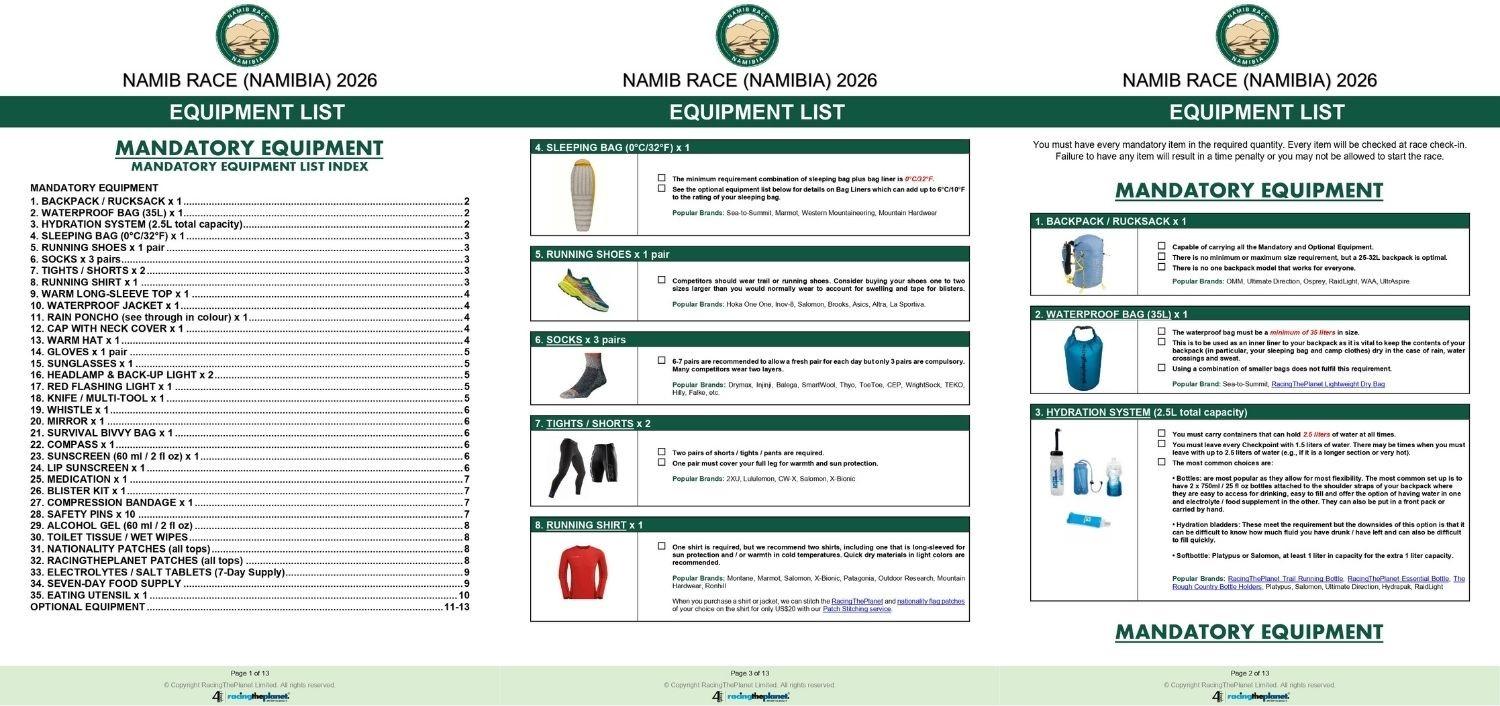
Equipment Checklist
- Understand every mandatory item.
- Look at what you have and what you still need to get.
- Focus on the key items early.
- Consider buying all the small items which make up more half of the list.
- Check that the items you have meet the requirements and you are happy with the weight and that it will work in the race conditions.
- Put in place a nutrition and electrolyte plan early.
- Consider if there are any optional equipment items that you may bring.
- Work out the weight of your pack and train accordingly.
How Heavy Will My Pack Be?
When finalising your equipment, it is important that you consider weight. You want to keep your pack as light as possible. An ideal weight is 7-10 kilograms / 15-22 pounds (without water).
Most Important Items
The key items to finalise early are your:
- Backpack / Rucksack
- Running shoes
- Hydration system
- Food & Electrolytes
You should be looking at these items early and plan to have them finalised by three months before the race.
SHOES
Trail shoes are recommended over road running shoes. Some recommended brands include Salomon, Brooks and Hoka One One.
Make sure you choose a comfortable model. Poorly fitting shoes can result in blisters which could prevent you from finishing the race. If you have a shoe that you have worn for a while and works for you then we would recommend you assess its suitability -- the shoes may very well be suitable for the Namib Race.
- Consider having 1+ sizes bigger than you would normally wear as you will be on your feet for a prolonged period of time, you may find that your feet swell.
- Consider the amount of mesh on the shoes – a shoe with less / tighter mesh is better to prevent sand, dust and debris from entering your shoes. Gaiters will also help with this.
Gaiters are the items that attach to your shoes to prevent sand and small stones getting in, either through any mesh that there is, or over the top of the shoes. These are an optional item but are highly recommended for the Namib Race. The course has a wide variety of terrain including every type of sand (including soft sand dunes). The gaiters that we recommend for the Namib Race are:
- Trail Running Gaiters which attach to your shoes with Velcro - one side of the Velcro needs to be permanently attached to your shoe. The gaiters themselves can be removed when not being used.
- Lightweight knee-length gaiters which need to be permanently attached and cover your entire shoe and can be pulled up to your knees.
- Salomon Trail Gaiters are lower gaiters which prevent debris from entering your shoes from the top. These are entirely removable without making any changes to your shoes, but are only helpful if you have shoes with minimal mesh on the front.
Foot care
Prevention is the key in foot care. You may want to read John Vonhof’s Q&A article on footcare, taping and blister prevention and watch this short three-part series on How to Look After Your Feet. A blister kit, including specific items, is a mandatory item and it is also recommended to use a lubricant, such as Bodyglide or Pjur Active, that helps to prevent blisters and chafing by reducing friction.
BACKPACK / RUCKSACK
The backpack is another key item as you will be carrying / wearing it at all times while you are on the course. Size, comfort and fit are the key features to consider. A 25-30L backpack is optimal. The expert article called Choosing a Pack is a recommended read before you make the final decision on your pack.
- We recommend training early with your backpack. It is better to start to add weight to the backpack gradually to avoid risking injury. It’s also recommended to alternate training sessions with and without a backpack.
HYDRATION SYSTEM
Every competitor must carry containers that are able to carry up to 2.5 liters of liquid. Some useful notes:
- You must leave each checkpoint with a minimum of 1.5 liters of water.
- At the final checkpoint of each day, you are allocated 4.5 liters of water which is to last you for the rest of the day, that night, the next morning, and then to the first checkpoint of the next Stage.
- Unlimited hot water is provided in the morning (from around 5am) and the evening (from 2pm to 9pm) for preparing meals and hot drinks. This must be used for consumption only.
- Water is provided from large 5L bottles.

We recommend that competitors use 2 x 750ml bottles that are easily accessible to fill at checkpoints and a 1L soft bottle that is kept inside your pack to be used only if it is possible / required to carry an additional 1L of water. The bottles are often attached to the backpack straps in bottle holders (as per photo below) or put in the side netting of the backpack.
Water bladders can also be used but they are not recommended as they usually require you to take your backpack off to refill which is not ideal. They can also be hard to put back into your pack when they have been re-filled. In addition, it is hard to know how much water you have left in a bladder and generally only allows either water or electrolyte mix, but not both.
FOOD & ELECTROLYTES
As well as the equipment, you have to bring, and carry, all your food, for the week! A minimum of 14,000 calories is required in total. This includes calories that come from liquid food / powders. You may find these two resources helpful.
- Planning Food & Electrolytes (recording of a Zoom information session).
- Food Planning spreadsheet mentioned on the previous Zoom recoding.
In addition to 14,000 calories for the race, you need to bring food for an evening meal at Camp 1. This food does not need to be carried so it can be heavier food – even consider “fresh” food or bringing a pizza from Swakopmund.
Electrolytes are also key. When you are doing exercise for an extended period of time you lose vital salts which need to be replaced. Electrolytes will help to do this. A mixture of powders or tablets that are dissolved in water and salt pills are recommended. See the Equipment List for details of how to calculate the right amount.
SLEEPING BAG
This is probably the most expensive item in the list. They key things to consider are warmth and weight. You must have a sleeping bag rated to 0C / 31F at the comfort level. A good sleeping bag that is mid-range in both warmth and weight and also good value is the Sea-to-Summit Spark SPII at around 700g / 1.5lb and a rating of -2C / 28F.
CLOTHING
You are required to bring the following clothing items – you can bring more (although it’s not recommended) but cannot bring less:
- Running top x 1
- Warm top x 1
- Waterproof jacket x 1
- Clear rain poncho x 1
- Shorts / trousers / tights x 2
Some people choose to bring an extra top to swap each day or wear at night. The make, model and type of clothing you bring is your choice.
PATCHES
All tops you bring must have RacingThePlanet and nationality patches attached as per the Patch Placement document.

- The RacingThePlanet patches will be sent to you in the mail about 3 months before the race.
- You need to purchase the nationality patches.
- Or you can silk screen both the patches to your tops, which is recommended. You can also consider using the patch stitching service.
- The race bib will be given to you in Swakopmund.
Optional but Recommended
As well as the mandatory equipment items you can bring anything extra that you choose. We recommend you keep these items to a minimum to keep your pack light. However, there are a few optional items that I would recommend that you consider bringing. These are:
- Sleeping Pad.
- Gaiters (see above).
- Trekking Poles.
- Toothbrush & toothpaste.
- Buff.
- Bowl or cup.
- Camp shoes.
There is also an option to bring your own single tent to sleep in each night. If you choose this option, then your tent will also be carried for you from Camp to Camp.
SMALL ITEMS
There are about 24 items on the list that you must have but their weight, design, etc. is minimal. For these I would recommend purchasing them early as that is more than 50% of the items that you no longer have to worry about. These include:
|
Available from RacingThePlanet Store |
|
(to line your backpack) |
| · Water bottles |
| · Poncho |
| · Warm hat / beanie |
| · Red flashing light |
| · Whistle |
| · Mirror |
| · Survival bivvy bag |
| · Compass |
| · Blister kit |
| · Compression bandage |
| · Safety pins |
| · Tablet towels |
| · Nationality patches |
| · Eating utensil (spoon / spork) |
|
Optional Items
· Gaiters |
|
Not Available from
RacingThePlanet Store |
| · 1L soft bottle |
| · Cap with neck-cover |
| · Gloves |
| · Knife / multi-tool |
| · Sunscreen |
| · Lip screen |
| · Alcohol gel |
| · Medication |
| · Toilet Paper |
RESOURCES
There are plenty of resources to help make sure that you have the right equipment, including food and electrolytes. Below are links to some articles, documents and videos that I highly recommend that you have a look at:
- Equipment List.
- Equipment & Food Recording by 4 Deserts Club member Michael Williams.
- FAQ on Equipment (in the Competitor Area).
- Q&A with the Namib Race 2021 Champion.
- Equipment for a 250km Ultra (recording of a Zoom information session).
- Planning Food & Electrolytes (recording of a Zoom information session).
- Food Planning spreadsheet mentioned on the previous Zoom recoding.
- Equipment Packing by past racers: Carlos Garcia (4 Deserts Club member).
- Expert Articles – there is a full range of expert articles on the RacingThePlanet website. You probably don’t need to read all of them at this stage in your preparation but have a look to see what’s there and read those that are relevant.
The RacingThePlanet Store stocks many of the items that are difficult to source elsewhere. Don’t forget that all confirmed competitors get a discount at the RacingThePlanet Store and Expedition Foods - if you don't have yours then please email me for details. However, note that it is not possible to ship to all countries.